
You’ve probably typed “more friendly” or “friendlier” and stopped to wonder wait, which one is actually right? It’s one of those small grammar questions that trips up even confident writers.
The good news is that both forms are correct. The real question isn’t which one is right it’s which one fits your sentence better. This guide breaks it all down simply.
Quick Answer: Both “friendlier” and “more friendly” are correct. “Friendlier” fits casual speech; “more friendly” suits formal or technical writing. Context decides.
Understanding Comparative Adjectives in American English
Most English speakers learn two clear rules for forming comparatives:
- Short adjectives (1 syllable): Add -er → tall → taller
- Long adjectives (3+ syllables): Use more → more beautiful
Two-syllable adjectives are trickier — and “friendly” is a perfect example of that confusion.
The standard grammar rule for two-syllable adjectives ending in -y is to drop the y and add -ier. That’s why we say happier, luckier, and heavier. Following this logic, “friendlier” is the textbook comparative form of “friendly.”
Yet “more friendly” shows up constantly — in professional emails, policy documents, and ad copy. So what’s actually going on?
Why “Friendly” Allows Both Forms
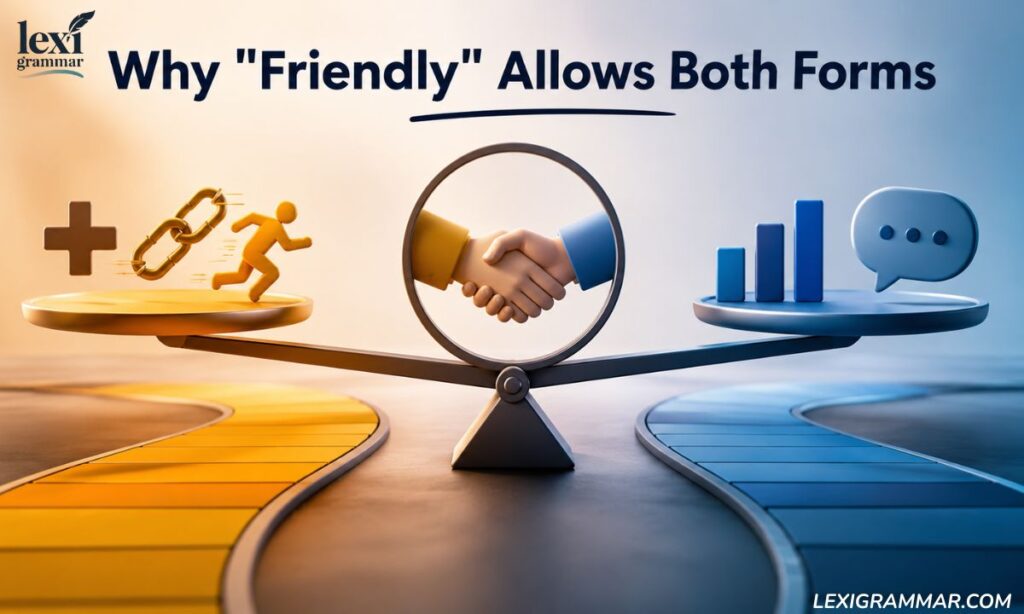
“Friendly” comes from the noun friend plus the suffix -ly, which visually mimics adverbs like quickly or slowly. That’s why many writers instinctively add more rather than -ier — it feels like the adverb pattern.
Spoken English has reinforced both over centuries. The Oxford English Grammar notes that two-syllable adjectives like friendly, noisy, and polite can form comparatives either way. Both are accepted. They just carry a different feel.
Friendlier or More Friendly Side-by-Side
| Feature | Friendlier | More Friendly |
| Form | Comparative suffix (-ier) | More + adjective |
| Tone | Warm, casual, conversational | Formal, deliberate, clear |
| Best for | Describing people and behavior | Technical, compound, or academic contexts |
| Syllables | 3 syllables | 4 syllables |
| Natural flow | Faster, smoother | Slightly more emphatic |
When You Should Use “Friendlier”
Use “friendlier” when you want writing that feels natural, warm, and easy to read. It works best in these situations:
- Comparing people or behavior directly: “She’s been much friendlier since joining the new team.”
- Casual or conversational writing: “Dogs are often friendlier than cats.”
- Emotional or storytelling contexts: “The town felt friendlier than anywhere I’d lived before.”
- Short, punchy sentences: The one-word form keeps the sentence tight and readable.
Most native speakers reach for “friendlier” in everyday conversation without thinking twice. It’s shorter, warmer, and gets out of the way.
When “More Friendly” Is the Better Choice
“More friendly” has a real place — it isn’t just a wordy alternative. These are the situations where it actually fits better:
- Formal or professional writing: “The revised policy is more friendly toward small business owners.”
- When the sentence already feels heavy: If the surrounding words are long, “more friendly” balances the rhythm better than the clipped “-ier” form.
- When making multiple comparisons: “The new interface is more friendly, more accessible, and more intuitive than the original.” (Parallelism sounds more consistent here.)
- When using adverbial emphasis: “The staff was noticeably more friendly after the training.”
Special Cases and Exceptions (Important!)
Compound Adjectives
This is the most important exception. When “friendly” is part of a hyphenated compound adjective, always use more — never attach -ier to the whole compound.
| Compound Adjective | Correct Form | Avoid |
| eco-friendly | more eco-friendly | ~~eco-friendlier~~ |
| user-friendly | more user-friendly | ~~user-friendlier~~ |
| budget-friendly | more budget-friendly | ~~budget-friendlier~~ |
| pet-friendly | more pet-friendly | ~~pet-friendlier~~ |
“More user-friendly” keeps the compound intact and reads cleanly. “User-friendlier” is a tongue-twister most writers — and style guides — skip entirely.
Technical or Scientific Writing
Technical writing values precision. In research papers, software docs, and academic reports, “more friendly” is the safer pick — it reads as objective rather than emotional, which fits the tone.
Example: “The updated formula is more environmentally friendly than its predecessor.”
Advertising and Branding
Marketing copy can use either form depending on what emotion the brand wants to convey:
- “Friendlier service, guaranteed.” — Feels human, approachable, and warm.
- “A more friendly banking experience.” — Sounds polished and intentional.
Both work fine. It comes down to what the brand sounds like.
Formal Tone vs. Casual Tone
| Context | Better Choice | Example |
| Text message to a friend | Friendlier | “She’s way friendlier now!” |
| Performance review | More friendly | “The candidate was more friendly in the second interview.” |
| Customer feedback survey | Either | “Our team is friendlier / more friendly than before.” |
| Academic paper | More friendly | “The interface was more friendly to first-time users.” |
When Emphasis Matters
When you want to stress the degree of friendliness — not just note it — “more friendly” adds weight. “She was more friendly than I expected” reads as more deliberate than “She was friendlier than I expected.” The meaning is identical; the emphasis shifts slightly.
“More Friendly” vs “Friendlier”: Real-World Side-by-Side Comparison
Case Study 1: Customer Service Teams
A company reviews customer feedback after a service training program. Customers described the team as “helpful but reserved” before training. After training, feedback read: “The staff feels friendlier and more approachable.”
Why “friendlier” here? Customers are describing people, not systems. In that context, “friendlier” feels natural — it’s how real people talk.
Case Study 2: App Redesign
A product manager writes in a design brief: “The new onboarding flow should feel more user-friendly and more friendly to non-technical users.”
Why “more friendly” here?
Two reasons: “user-friendly” is a compound adjective (must use “more”), and the professional document context calls for formal phrasing.
Case Study 3: Environmental Policy
A government report states: “The revised regulation is more environmentally friendly toward rural farming communities.”
Why “more friendly” here?
Policy documents aren’t casual. “More friendly” keeps the tone consistent with the rest of the report and avoids any informal slip.
Practical Guidelines for Choosing the Right Form
Five quick checks to settle the decision before you publish:
- Is “friendly” part of a compound adjective? → Always use more (more eco-friendly, more user-friendly)
- Are you writing formally or technically? → Lean toward more friendly
- Are you describing a person or behavior casually? → “Friendlier” sounds more natural
- Does the sentence feel clunky with either form? → Rewrite the sentence entirely
- Are you using multiple comparisons in a list? → Match the form across all of them for consistency
Quick “Say It Out Loud” Test
Read both versions aloud:
“The new receptionist is friendlier than the last one.” “The new receptionist is more friendly than the last one.”
Whichever feels less forced is probably the right one. Grammar evolved through speech — your ear has absorbed thousands of hours of it.
5 Common Myths About “More Friendly” vs “Friendlier”
Myth 1: “Friendlier” is informal and shouldn’t appear in professional writing.
Truth: “Friendlier” is perfectly correct in professional contexts when describing human behavior or attitude.
Myth 2: “More friendly” is always more grammatically correct.
Truth: Both forms are equally correct. “More friendly” is not more proper — it’s just more formal.
Myth 3: You can say “eco-friendlier.”
Truth: Compound adjectives almost never take the -er suffix. Stick with “more eco-friendly.”
Myth 4: Native speakers never say “more friendly.”
Truth: Native speakers use both forms. Context and rhythm drive the choice.
Myth 5: The superlative is “most friendly.”
Truth: Both “most friendly” and “friendliest” are correct, following the same logic as the comparative forms.
Frequently Asked Questions
Is “friendlier” a real word?
Yes — it is the standard comparative form of “friendly,” accepted in both formal and informal English.
Which is more grammatically correct: “friendlier” or “more friendly”?
Both are equally correct; the choice depends on tone and context, not grammar rules.
Can I use “more friendly” in an email?
Yes — it works well in professional emails where a slightly more formal tone is appropriate.
What is the superlative of “friendly”?
Both “friendliest” and “most friendly” are correct superlative forms.
Is “eco-friendlier” correct?
No — compound adjectives like “eco-friendly” require “more eco-friendly,” not the -ier suffix.
Does “friendlier” sound too casual for a resume or CV?
In most cases, “more friendly” is the safer, more polished choice in formal documents like resumes.
Which form do American English style guides prefer?
Most style guides accept both; however, AP Style and academic guides tend to favor “more friendly” in formal contexts.
Conclusion
There’s no winner here — both forms are correct, and neither is superior. What changes is the feel.
“Friendlier” is the go-to for everyday writing, descriptions of people, and anything where warmth matters. “More friendly” belongs in formal documents, technical copy, and anywhere a compound adjective like eco-friendly or user-friendly is involved.
Still unsure? Say both versions aloud. Go with the one that doesn’t make you pause. That’s usually enough.

Alex is a content creator passionate about sharing ideas that inspire, inform, and connect with readers. His work blends practical insights with a touch of creativity, making content engaging and easy to understand.