
Three words. One source of confusion. If you have ever typed the wrong one in an email, a message, or a school assignment, you are not alone. Incoming, upcoming, and oncoming look and sound like close relatives, yet each one carries a meaning the other two simply cannot cover.
This guide breaks down exactly what sets them apart — with real examples, a side-by-side table, memory tricks, and answers to the questions people ask most.
Understanding “Incoming”, “Upcoming”, and “Oncoming”
All three words are adjectives. All three describe something that has not fully happened yet. That is where the similarity ends.
The real split comes down to three separate ideas:
- Arrival → something is coming in right now
- Scheduling → something is planned for the near future
- Direction → something is physically moving toward you
Once you attach each word to one of those ideas, the confusion disappears.
What “Incoming” Really Means
Incoming describes something that is actively arriving — something entering a space, a system, or a person’s reach right now or very soon.
It covers both physical and digital situations:
- An incoming call is ringing on your phone at this moment
- Incoming mail refers to letters or packages being delivered to you
- Incoming students are new arrivals joining a school or program
- An incoming tide is water actively moving toward the shore
- Incoming fire or an incoming missile signals something heading directly at a target
The word “in” is built right into it — something is coming in. That’s the core idea: receipt, arrival, entry.
Quick test: Can you receive it, accept it, or be hit by it right now? Use incoming.
What “Upcoming” Really Means
Upcoming describes something that is scheduled or expected to happen in the near future. There is no movement involved — just time.
Think of a calendar. Anything that sits on a future date can be called upcoming:
- An upcoming exam is one you will take next week
- An upcoming concert has already been announced and is on the schedule
- An upcoming product launch has a release date but hasn’t happened yet
- An upcoming deadline is approaching on the timeline
This word is calm and neutral. It does not carry urgency the way “incoming” sometimes does. It simply means: it’s planned, and it’s coming up on the calendar.
Quick test: Can you circle it on a calendar? Use upcoming.
What “Oncoming” Really Means
Oncoming is the most physical of the three. It almost always describes something moving toward you in space — often fast, often directly in front of you, and often carrying a sense of danger or urgency.
Common contexts where “oncoming” belongs:
- Oncoming traffic — vehicles approaching from the opposite direction
- Oncoming storm — a weather system moving toward your location
- Oncoming train — a train heading straight toward you on the tracks
- Oncoming wave — a large wave rushing toward shore
You will rarely see “oncoming” in a digital or scheduling context. It almost always involves something moving through physical space. That directional quality — something bearing down on you — is what makes it unique.
Quick test: Is it rushing toward you through space, often from the opposite direction? Use oncoming.
Side-by-Side Comparison
| Word | Core Idea | Movement? | Scheduled? | Common Contexts |
| Incoming | Arrival / receipt | Yes (entering) | Not necessarily | Calls, emails, new students, shipments, tides, missiles |
| Upcoming | Scheduled / future event | No | Yes | Exams, meetings, concerts, deadlines, elections |
| Oncoming | Physical approach toward you | Yes (toward you) | No | Traffic, storms, trains, vehicles, waves |
Why Context Matters
Each word only sounds right in the right context. Native speakers pick up on mismatches instantly — even if they cannot explain why.
Consider these three sentences about weather:
- “The incoming storm will hit us in the next hour.” ✅ — the storm is actively moving toward the area right now
- “The upcoming storm season starts in June.” ✅ — it’s on the calendar, months away
- “Drivers slowed down because of the oncoming storm.” ✅ — the storm is physically approaching their position
Swap them around and the sentences sound odd immediately. Context — timing, direction, and whether something is received or scheduled — determines which word fits.
Examples from Everyday Life
Workplace:
- “I have 14 incoming emails to sort through this morning.”
- “Please block your calendar for the upcoming team training on Thursday.”
On the road:
- “She swerved to avoid the oncoming truck.”
- “Incoming deliveries are unloaded at the back entrance.”
School:
- “Incoming freshmen should register before August 15.”
- “Start studying now — the upcoming finals are in three weeks.”
Weather and news:
- “The incoming hurricane is expected to make landfall tonight.”
- “The upcoming election is the most watched in years.”
- “Cyclists moved to the side of the road as oncoming vehicles approached.”
Common Mistakes to Avoid
These are the errors that come up most often:
❌ “I prepared for the incoming festival.” ✅ “I prepared for the upcoming festival.” — A festival sits on a calendar. It doesn’t arrive like a package.
❌ “Watch out for the upcoming car!” ✅ “Watch out for the oncoming car!” — A car bearing down on you is moving through space, not sitting on a schedule.
❌ “We have an incoming meeting tomorrow.” ✅ “We have an upcoming meeting tomorrow.” — A meeting is planned, not arriving at your inbox.
❌ “Be careful of incoming traffic.” ✅ “Be careful of oncoming traffic.” — Traffic in the opposite lane is directional and physical, not arriving to you.
Easy Memory Tricks
These simple mental hooks will make the right choice automatic:
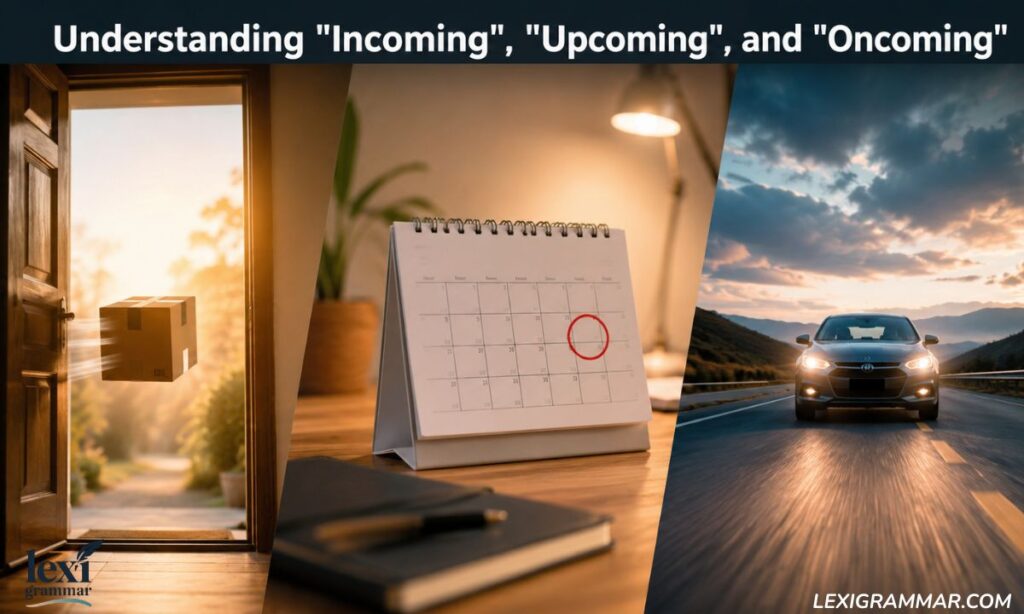
- INCOMING → Think of a doorbell. Something is coming to you right now. A call, a package, a tide — it’s arriving.
- UPCOMING → Think of a calendar with a date circled. It’s up next in time. Nothing is moving; it’s simply scheduled.
- ONCOMING → Think of headlights in the opposite lane heading straight at you. It’s on your path, moving in your direction through space.
Another fast rule:
- If “call” or “email” fits naturally after the word → incoming
- If “event” or “exam” fits naturally → upcoming
- If “traffic” or “train” fits naturally → oncoming
Case Studies
Case Study 1: The School Email
A school administrator writes: “Please welcome our incoming students and remind them about the upcoming orientation session.” Both words are used correctly here. The students are arriving (incoming). The session is scheduled (upcoming). If the admin had written “oncoming students,” it would imply students rushing at you down a hallway — a very different image.
Case Study 2: The Weather Report
A news anchor says: “An incoming storm system will bring heavy rain tonight. Our upcoming weather coverage continues at 9 PM.” Again, both are correct. The storm is actively moving in (incoming). The coverage is on the broadcast schedule (upcoming).
Case Study 3: The Road Sign
A road sign reads: “CAUTION: Oncoming traffic may not stop.” Not “incoming traffic.” Not “upcoming traffic.” The sign is warning about vehicles moving toward you from the opposite direction — pure physical direction, which is exactly what oncoming communicates.
Quotes to Help You Remember
“Incoming is what hits your inbox. Upcoming is what’s on your calendar. Oncoming is what’s in your lane.”
“If it’s arriving, say incoming. If it’s scheduled, say upcoming. If it’s rushing at you, say oncoming.”
Frequently Asked Questions
Can “incoming” and “oncoming” ever be used interchangeably?
Rarely — “incoming” can describe physical movement in some contexts (an incoming ball), but “oncoming” is always directional, physical, and usually urgent. They are not true synonyms.
Is “upcoming” always about the future?
Yes — upcoming always refers to something scheduled or expected ahead of time. It never describes something arriving right now.
Can I say “oncoming storm” or should I say “incoming storm”?
Both can work depending on context — “oncoming storm” emphasizes physical movement toward you; “incoming storm” highlights that it is about to arrive at your location.
Why does “oncoming traffic” sound right but “incoming traffic” sound wrong?
Because “oncoming” signals directional movement from the opposite side, which is exactly what traffic in the other lane does. “Incoming” would imply traffic entering a space, like arriving at a loading dock.
Can “upcoming” be used to describe something that’s just hours away?
Yes — upcoming works for anything from hours to months away, as long as it’s planned and on a timeline.
Is “oncoming” always negative or dangerous?
Not always, but it often carries urgency — it’s used most in contexts where awareness and reaction matter.
What’s the difference between “incoming” and “forthcoming”?
“Incoming” is about arrival right now; “forthcoming” has a more formal tone and means something will be released, revealed, or provided soon.
Conclusion
The difference between incoming, upcoming, and oncoming is not complicated once you anchor each word to its core idea. Incoming is about arrival — something entering right now. Upcoming is about scheduling — something planned for the future. Oncoming is about direction — something physically moving toward you.
Use the calendar rule, the doorbell image, and the headlights picture whenever you’re in doubt. With a little practice, the right word will come naturally every time — and your English will sound cleaner and more precise for it.

Alex is a content creator passionate about sharing ideas that inspire, inform, and connect with readers. His work blends practical insights with a touch of creativity, making content engaging and easy to understand.